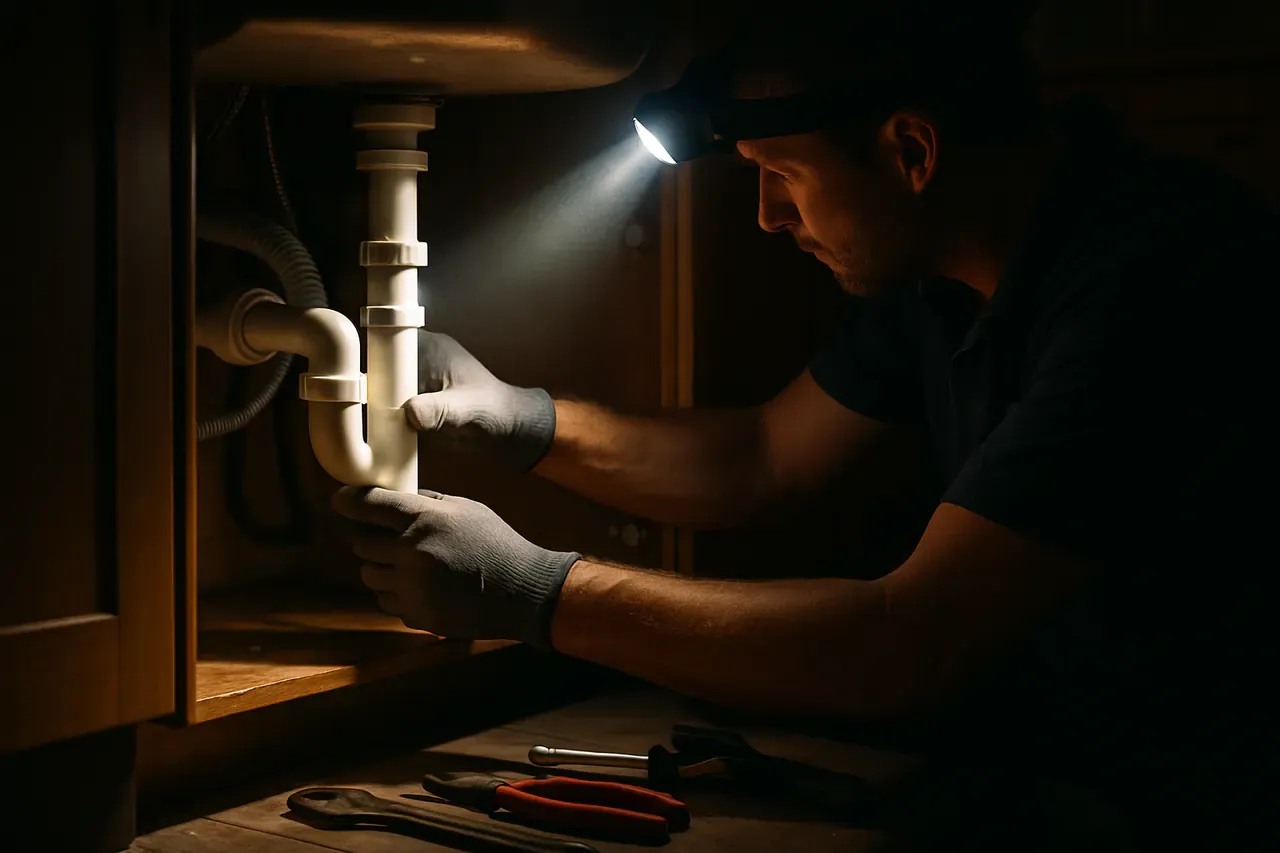
Some plumbing problems can wait for a convenient appointment. The ones this page is about can’t. A burst pipe fills a wall cavity at hundreds of litres an hour. Sewage coming up the floor waste makes a home unliveable by the minute. A gas smell is a straightforward safety issue. For these, requests are received 24 hours a day across the Eastern Suburbs — nights, weekends, public holidays — and passed to licensed local plumbers who take emergency work at $120-160 an hour, any hour, with no call-out fee.
What counts as a real emergency
Call immediately — any hour — for:
- Burst or badly leaking pipes you can’t isolate
- Sewage backing up through toilets, floor wastes or gully traps
- Gas smells anywhere in or around the property
- No water at all, or water pouring through a ceiling or light fitting
- Leaking hot water tanks — a weeping tank can split without much warning
- Flooding from failed stormwater during heavy rain
If you’re not sure it’s an emergency, send the request anyway and describe it. Any plumber you engage should hold a current licence, which you can check with NSW Fair Trading. Sometimes the honest answer is “shut this one valve and book the morning at the standard rate”: the plumber would rather tell you that than sell you a 2am visit you didn’t need.
What happens when you send a request
- Tell us what’s happening. Suburb, the problem, and whether the water or gas is off. The guide on this page shows which valve to shut and what to stop using, so things stop getting worse before the plumber arrives.
- A licensed local plumber replies as soon as one is available. The reply confirms the rate in writing and how long the trip will take; Eastern Suburbs distances are short but the traffic is real, so nobody promises a number they can’t keep.
- Stabilise first. The first job on site is stopping the water, gas or sewage. Then a proper assessment.
- You approve before the repair. Even at 3am, you’re told what’s wrong, what fixing it involves and what it costs — before the work happens.
Built for the Eastern Suburbs’ emergencies
The area’s housing writes the emergency schedule. Century-old galvanised services in Paddington terraces burst without notice. Coastal salt in Bondi and Coogee eats hot water tanks until one evening the laundry floor is wet. Root-bound clay sewers in Randwick pick long weekends to block completely. Blockages in the main sewer itself are Sydney Water’s responsibility. Strata stacks in Eastlakes walk-ups turn one flat’s problem into a building’s. The plumbers who take these jobs carry the parts they actually need — pipe repair fittings for every generation of local pipework, valves, cistern internals — because a 2am repair shouldn’t wait for a 7am supplier.
Save the number before you need it
Nobody researches plumbers calmly with water coming through the ceiling. Save this page now, and if tonight’s the night something lets go anywhere in the Eastern Suburbs — Bondi to Eastlakes, Paddington to Maroubra — send the request or call. A licensed local plumber replies as soon as one is available.
What it costs
Work on this page is charged by the hour: $120-160 an hour for a genuine emergency at any hour of the day or night, travel included, with no separate call-out fee, and $180-300 an hour for non-urgent work you choose to have done after hours, on a weekend or on a public holiday. Parts are shown separately on the quote, and the plumber confirms the price in writing before work starts.
Emergency, or can it wait?
Get a plumber now
Damage, danger or no essential service
- A burst pipe or flexi hose you cannot stop at the meter
- Sewage coming up through a floor waste, toilet, shower or the gully in the courtyard
- A smell of gas: leave the house, then call 000 or Jemena on 131 909
- No water at all to the property
- A hot water tank leaking from the body, or spraying, especially on a rooftop above other flats
- A toilet overflowing, or blocked in a one-toilet home
- Water near power points, lights or the switchboard
It can wait for a daytime visit
Annoying, but not getting worse by the hour
- A dripping tap or shower head
- One slow drain while the others run fine
- A toilet that keeps running
- Low water pressure with no visible leak
- Noisy or banging pipes (water hammer)
- Hot water that runs out sooner than it used to
Where to turn the water off
Terrace or semi
At the front, but often hidden: a brass box set into the front path or step, behind the iron fence, or against the front wall by the door.
- Lid may be brass, concrete or plastic and painted over
- Shared rows: make sure it is your meter, not next door's
- A flathead screwdriver lifts a stuck lid
Free-standing house
In a small in-ground box at the front boundary, near the footpath or the driveway.
- Green or black plastic lid, or concrete on older homes
- On the house side of the meter you will find the stop tap
- Lid often says WATER METER
Flat or apartment
Your own stop tap is inside the unit: in the laundry, behind the bathroom or kitchen inspection panel, or in the hot water cupboard. The building tap is not yours to touch.
- Isolation taps under the kitchen sink and behind the washing machine
- Older walk-ups may have one tap per flat in the stairwell cupboard
- Tell the strata manager if water may reach the flat below
Lever handleTurn it a quarter-turn. Across the pipe means off.
Round wheelTurn clockwise until it stops, usually 8 to 10 full turns.
Which tap?The stop tap on the house side of the meter. The meter and the street side belong to Sydney Water.
Frequently Asked Questions
Are you really available at 3am on a public holiday?
Yes. Requests are received around the clock, every day of the year, and go to licensed local plumbers who take night and public-holiday work. A genuine emergency costs the same $120-160 an hour at 3am as at 3pm; what changes at night is how long it takes to get there, which depends on where the nearest available plumber is. The plumber who replies tells you both before anything is agreed.
What should I shut off before you arrive?
Water emergencies: the main meter tap, usually at the front boundary in a ground-level box — then open an outside tap to drain pressure. Gas smells: the valve at the gas meter, switches untouched, everyone outside. Sewage backups: stop running any water into the drains. The guide on this page shows where each shut-off usually is.
Do you charge more for after-hours work?
For a genuine emergency, no: the rate is $120-160 an hour at any hour, with no separate call-out fee. Non-urgent work you choose to have done after hours, on a weekend or on a public holiday is $180-300 an hour. The plumber confirms which applies, in writing, before you agree, and the price for the repair is agreed before work starts. No 4am surprises on the invoice.